Loading...
Serving Downey, CA and surrounding areas. (562) 636-0357
Serving Downey, CA and surrounding areas. (562) 636-0357
Clay soil, earthquake country, and 60-year-old homes demand more from a slab pour. We handle soil prep, steel, permits, and inspections so your foundation lasts.
Slab foundation building in Downey means pouring a reinforced concrete base directly on prepared ground - most residential projects take three to seven days of active work, plus one to two weeks for permit approval, and about 28 days of curing before full loads can be placed on top.
If your home is from the 1950s or 1960s, you are probably dealing with a slab that was poured before modern seismic and soil standards existed. Downey's clay-heavy soils expand and contract with every wet and dry season, and that repeated movement is what causes older slabs to crack, shift, and slope over time. Whether you are replacing a failing slab or pouring a new one for an addition or accessory dwelling unit, the process requires real site preparation - not just a quick pour.
A slab foundation is also closely related to foundation installation work - if your project involves replacing a full foundation rather than just a slab, both services may be part of the same job.
If interior doors have started dragging on the floor or windows feel stiff and hard to open, the frame of your home may be shifting. In Downey, this kind of movement is often connected to clay soil expanding and contracting with seasonal moisture changes. It does not always mean the foundation has failed, but it is worth having a professional look sooner rather than later.
Small hairline cracks in a concrete floor are common and usually harmless, but cracks wider than a pencil, running diagonally, or with one side higher than the other are a different story. In older Downey homes from the mid-20th century, these kinds of cracks often signal that the original slab has reached the end of its useful life. Cracks that seem to be growing or changing over time are a clear signal to get an evaluation.
Walk slowly across your floor in socks and pay attention to whether it feels level. If one area feels noticeably lower or higher than another, or if a marble placed on the floor rolls on its own, the slab underneath may have shifted or settled unevenly. This is especially common in parts of Downey where older drainage infrastructure has allowed water to pool under homes over decades.
If you notice damp patches, white chalky deposits, or a musty smell coming from your concrete floor, moisture may be migrating up through the slab from the ground below. In Downey, where summer irrigation and occasional heavy winter rains can raise the water table temporarily, this is not uncommon in homes where the original vapor barrier has degraded. A new slab with a properly installed moisture barrier solves this permanently.
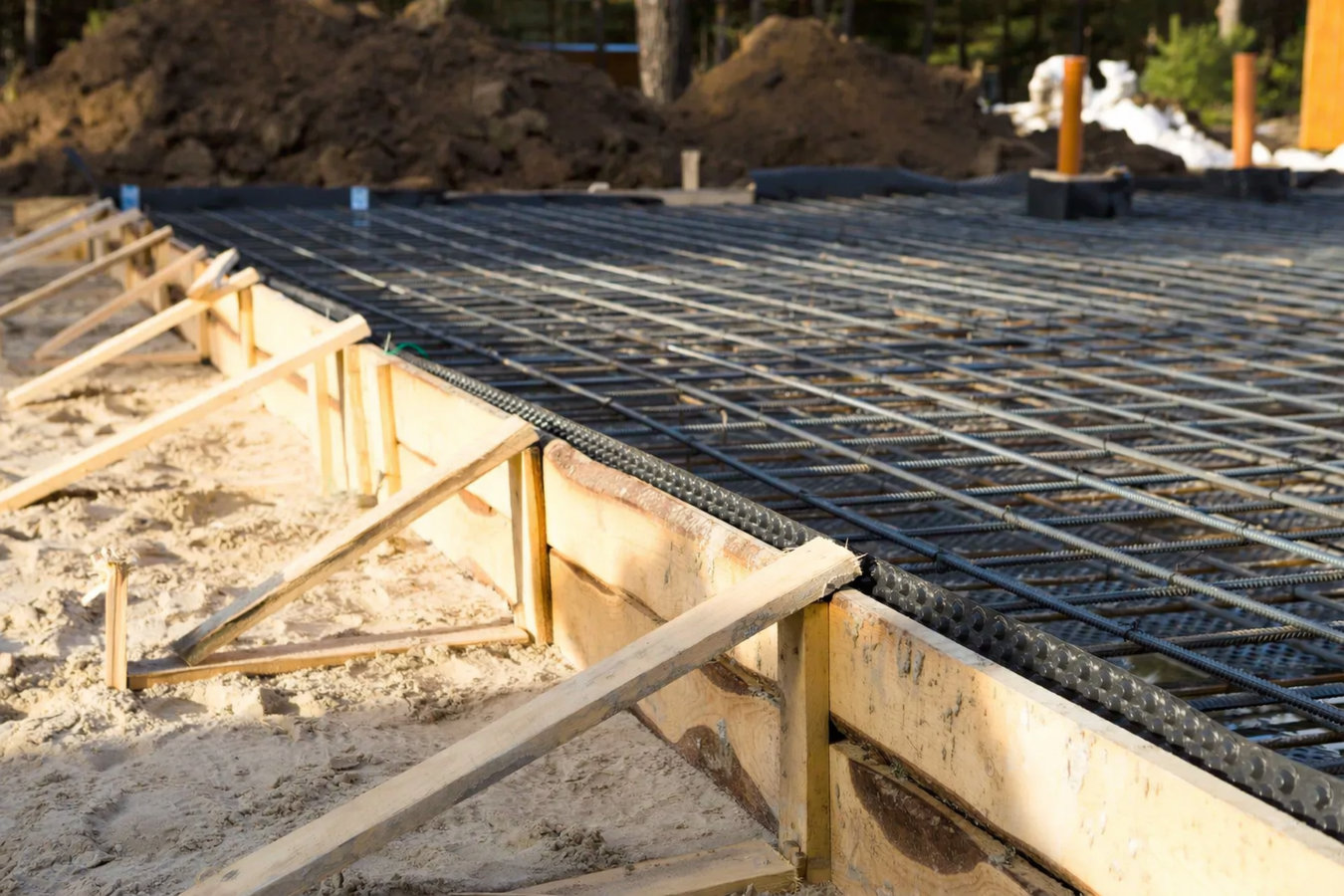
Every slab foundation we build starts with the ground itself. That means grading and compacting the soil, laying a gravel base for drainage, and installing a plastic vapor barrier to keep moisture from migrating up through the finished slab. In Downey, where clay soils shift seasonally, this preparation work is not optional - it is what separates a slab that holds for decades from one that cracks within a few years.
Once the site is ready, we place a grid of steel reinforcement before any concrete is poured. You will not see the steel once the job is done, which is exactly why the City of Downey's pre-pour inspection matters - a city inspector verifies the reinforcement is correctly placed before the concrete covers it permanently. This step also satisfies California's seismic requirements for the LA Basin.
Beyond new slab pours, we handle replacement slabs for existing homes, slab pours for home additions and ADUs, and the footings work that ties into concrete footings at the perimeter. For homeowners looking at broader structural work, this often connects to a full foundation installation project.
Suits homeowners building an addition, ADU, or new garage on their Downey property.
Suits homeowners with cracked, shifted, or moisture-damaged slabs from the mid-20th century building era.
Suits projects where wall loads require thickened edges sized to local soil conditions and seismic requirements.
Most of Downey was built out during the 1950s and 1960s, when postwar families filled the neighborhoods around Firestone Boulevard and the surrounding streets. That means the original concrete slabs under many local homes are now 60 to 70 years old - well past their practical lifespan. Downey's clay-heavy soils have been expanding and contracting under those slabs every single year, and the combination of age and soil movement is what brings most of our clients to us. This is not a generic concrete job; it requires someone who understands what the ground is actually doing under a Downey property.
California's seismic requirements add another layer. Downey sits near active fault systems in Los Angeles County, and the state's building code requires that residential foundations in this area include specific steel reinforcement and perimeter footing depths designed to handle ground shaking. The City of Downey enforces this through its pre-pour inspection process. A contractor who pulls permits and works with inspectors - rather than around them - is the only contractor you should trust with this job. Learn more from the California Geological Survey on LA Basin soil conditions.
We work throughout the Downey area and in neighboring communities including Norwalk, Compton, and Long Beach. The soil conditions and housing stock across the LA Basin share enough similarities that our local experience applies across the region.
We reply within one business day. You will get a straight answer on whether we can help and what a site visit involves - no vague estimates over the phone before we have seen your property.
We visit your property, assess the soil conditions, measure the area, and review any existing concrete that needs to be removed. You receive a written, itemized estimate that separates labor, materials, permits, and demolition costs before you commit to anything.
We apply for the required City of Downey building permit - typically one to two weeks for approval. Once the permit is in hand, the crew grades and compacts the site, lays the gravel base, and installs the vapor barrier.
Steel reinforcement is placed and a city inspector verifies it before the concrete is poured. The pour itself is a single-day event. After curing - about a week before heavy loads, and 28 days to full strength - a final inspection closes the permit.
We handle permits, inspections, and soil prep. Free written estimate, no pressure.
(562) 636-0357Every slab foundation we build in Downey goes through the City of Downey Building and Safety Division permit process. That means there is an official record of the work, inspected and approved - which protects you when you refinance, sell, or make an insurance claim.
Downey sits on clay soils that expand and contract with every wet and dry season. We account for this from the start with proper compaction, the right gravel base, and perimeter footings sized for local conditions - not a one-size-fits-all spec from another region.
California requires a pre-pour inspection to verify the reinforcement is correctly placed before the concrete covers it. We schedule this inspection as a standard step on every job, not something you have to ask for. The city inspector signs off, and then we pour.
We have built slabs on properties across Downey and surrounding LA County cities, including homes on the same streets for years. That local track record means we know the permit office, the soil types, and what inspectors look for in this specific area. See what the American Concrete Institute says about residential slab standards.
Every one of these points comes back to the same thing: a slab foundation is not a commodity job where the cheapest bid wins. The ground conditions in Downey, the city's permit requirements, and California's seismic standards all mean this work has to be done right - and we have built our reputation on doing exactly that.
Full foundation installation for new builds and major replacements on Downey properties.
Learn moreStructural footings that carry wall and column loads into the ground safely.
Learn morePermits, inspections, and soil prep handled for you - the longer you wait on a shifting slab, the more it costs to fix.